

G-Search Ltd. (G-Search) is a Fujitsu Group company whose businesses are data business and digital solutions. In data business, it provides JDream III, one of Japan's largest databases of scientific and technical literature, and the G-Search Database Service, which collects information on about 1.45 million companies across Japan. In digital solutions, it offers everything from digital marketing to CMS (content management systems). It provides a wide range of digital services as web services and SaaS, used by many companies.
01Background
Maximizing the business with data, and improving the customer experience
As the number of services G-Search provides kept growing, executing marketing and sales strategies that make use of data had become a priority. But each existing service implemented its own authentication, which made it hard to bring data together. For convenience, users were also asking for SSO, so they could use multiple services with one ID.
Against this background, building a shared authentication platform to maximize the business through data-driven initiatives and improve the customer experience had become an urgent task within G-Search. As a solution, the company envisioned an “account management platform”: a set of features including authentication and authorization across services and a portal for managing user information. As the study went on, it became clear that beyond authentication and authorization, back-end functions such as service management, billing management and organization management, as well as management screens for users and operators, would need to be built.
02Why Tactna
While looking for an account management platform that could solve this, G-Search came across Tactna Identity Platform (Tactna), provided by TC3. Tactna is a customer engagement hub that works with a range of IDaaS products. Besides serving as an integrated ID platform across multiple services, it provides management portals for customers and operators as SaaS.
The “account management platform” G-Search had in mind centered on authentication and authorization with SSO across multiple services, plus management screens for users and operators, and it turned out that Tactna could solve many of the requirements. The table below compares some of the requirements for scratch development and Tactna, explained in detail against the reasons for adoption.
| Requirement | Built from scratch | Tactna (feature name in parentheses) | |
|---|---|---|---|
| Authentication and authorization | Per user | ◎ (with an IDaaS) | ◎ (with an IDaaS) |
| Per organization | ☓ Must be built | ◎ (with Tactna Core) | |
| Multiple services | ☓ Must be built | ◎ (with Tactna Core) | |
| Portal site | For users | ☓ Must be built | ◎ (portal site) |
| For operators | ☓ Must be built | ◎ (portal site) | |
| Custom components | ☓ Must be built | ◯ (with Embedded UI) | |
| Extensions | Billing management | ☓ Must be built | ◯ (with Workflow Hook) |
| Contract and service management | ☓ Must be built | ◯ (with Workflow Hook) | |
| Integration with internal systems | ☓ Must be built | ◯ (with Workflow Hook) | |
Reason 1: Standards-based authentication and authorization that can model organizations
For a simple implementation of authentication and authorization alone, IDaaS products such as Amazon Cognito or Okta Customer Identity Cloud (Auth0) can be used. While they support authentication and authorization per user, authorizing per organization or serving multiple services from one authentication platform is difficult with them, and we could not find a good approach. Tactna provides, as Tactna Core, a way to model organizations — grouping a company, department and so on into one unit — and a mechanism for managing authorization information across multiple services, and that pushed us to adopt Tactna. Being able to leave global security standards compliance and monitoring and operation of the authentication and authorization layer to Tactna was another big reason.
Reason 2: Portals for users and for operators
Whether you run one app or several, it is common to have users handle everything themselves, from signing up for the service to entering their basic information. That calls for a portal site such as a My Page.
Operators also need a portal site with operational features so they can handle password resets for users and many other management tasks. These portals contribute little to the business in application development, so they tend to lack usability. Being able to implement a simple My Page and operations portal quickly with Tactna was the second reason for adoption.
Reason 3: Extensibility for internal-system integration and business requirements
Finally, delivering the user experience and meeting operational constraints often means handling requirements specific to the service provider, such as billing, contract management and integration with internal systems. Tactna provides a mechanism for building logic to match the provider's requirements (Workflow Hook) and for adding custom components flexibly (Embed UI). This flexibility was the third reason for adoption.
03System architecture
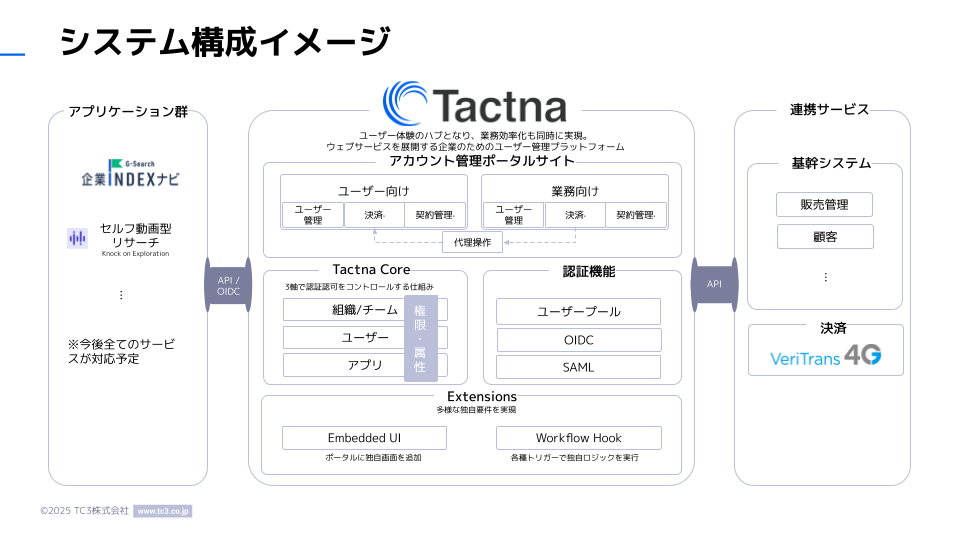
The project was launched as the “G-Search Account Platform,” and development using Tactna's features began. In the requirements phase, the team worked out G-Search's own requirements on the portal side, mainly the integration with the Veritrans 4G payment service and changes to contract plans that users can make themselves.
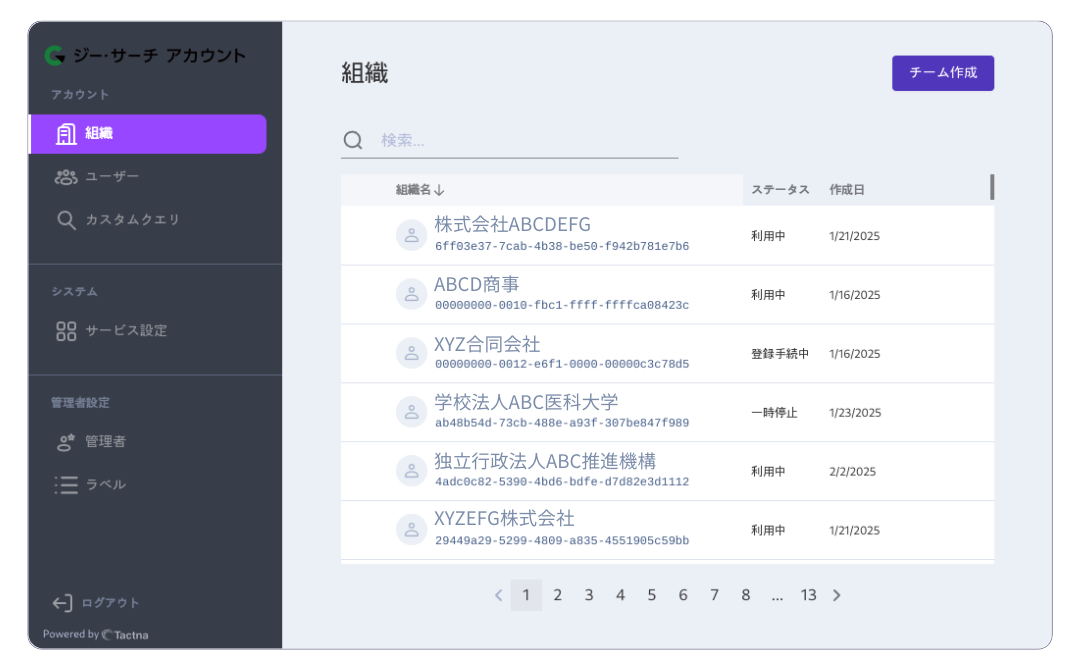
04The implemented screens
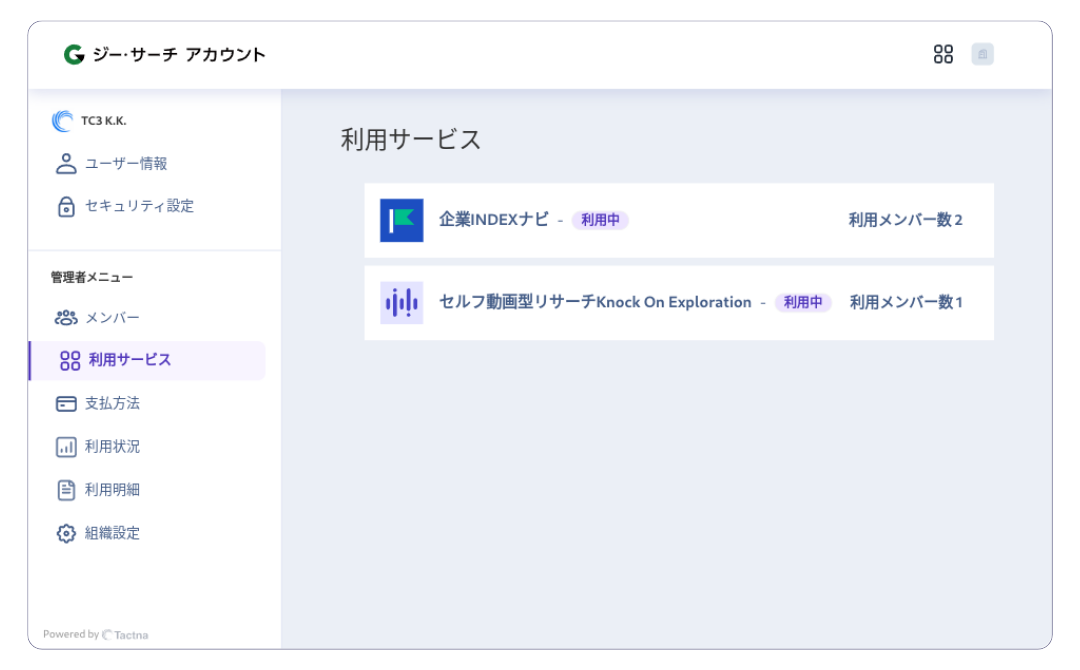
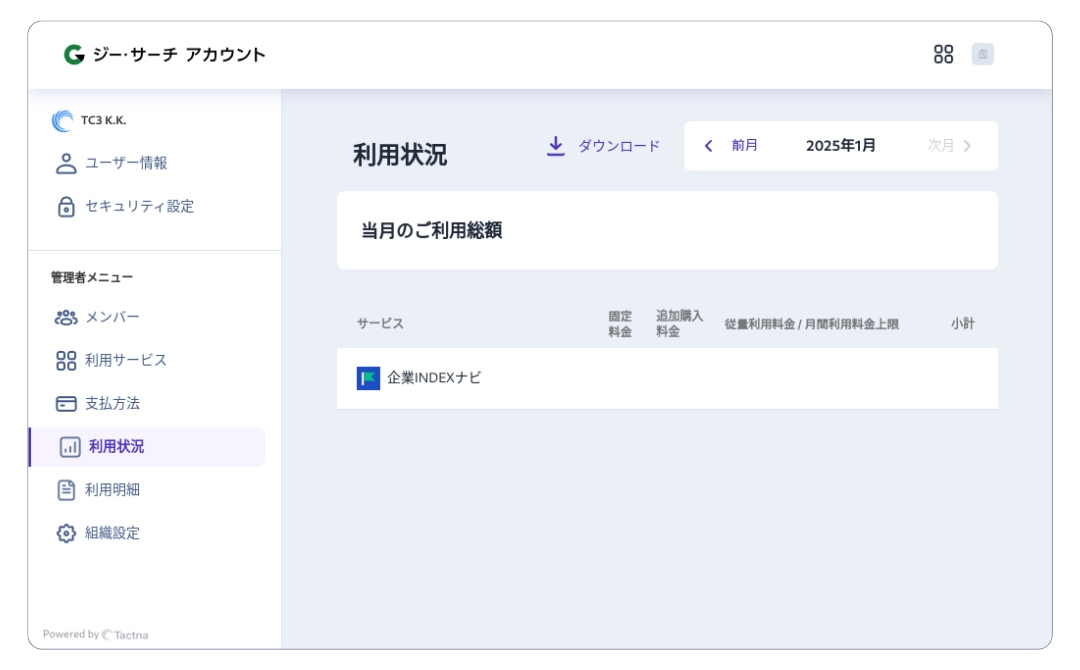
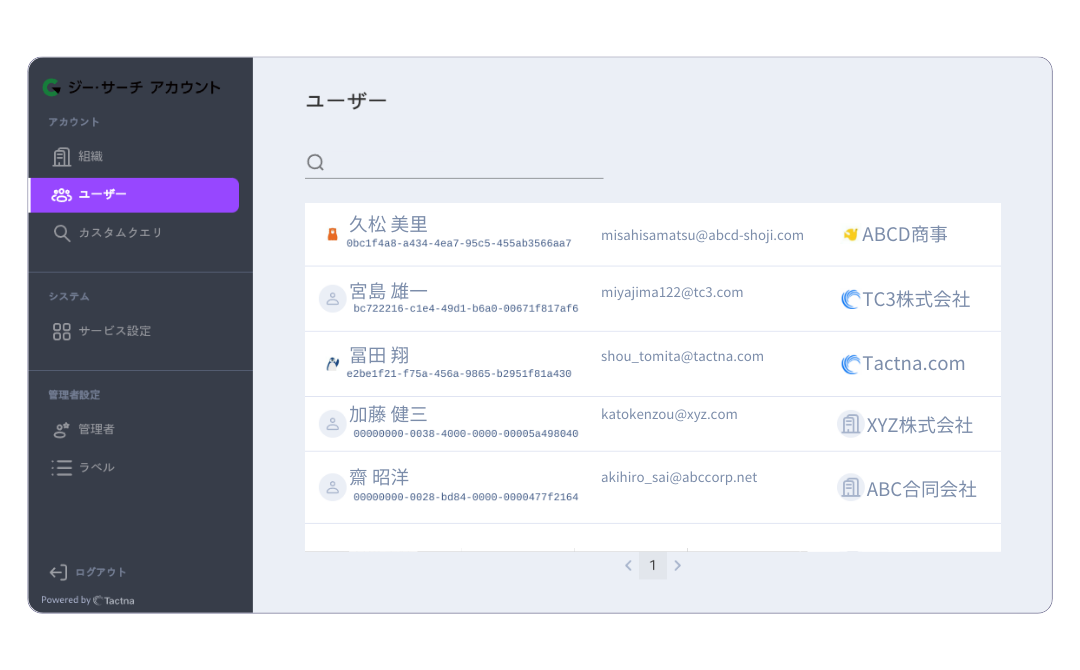
Below are some of the management screens implemented for users and for operators.
05Results
Authorization built for B2B business
At first, the challenge was that an account management platform authorizing per company or per department could not be built with the features of existing IDaaS products alone. Tactna Core, the Tactna feature that controls attributes and permissions on three axes — organizations, apps and users — made it possible to solve this. Adopting Tactna was a big step toward the goal of a platform for B2B business across multiple services.
Fast rollout
Bringing in multiple services and the concept of organizations usually requires complex requirements definition and design for authentication and authorization, such as sorting out use cases on the application side. Add the design of management screens for users and operators, and the development team can balloon and the schedule stretch out. Despite these conditions, by adopting Tactna's best practices and building extensions, G-Search completed in about 6 months a project that would normally take about a year.
High-quality features
Even with the short timeline, drawing on TC3's know-how let us cover points that are easy to overlook with in-house resources alone, and roll out with little rework. By meeting the latest security requirements for identity management while aligning our operations with Tactna's specifications as far as possible, we raised the quality of the authentication platform as a whole.
06Outlook
The management portal is already live for one service, and support for the other services will follow in turn. Over the next two years, G-Search plans to have all of its web services connected to and running on the G-Search Account Platform (Tactna). It also plans further integration with MA tools and its data analytics platform as it works to grow the business. Better convenience for customers should also bring effects such as upselling.
From the customer
Adopting Tactna Identity Platform gave us the foundation for the data utilization we ultimately want to achieve. We plan to move all of our services onto Tactna, and since we will no longer need to study and implement identity areas — authentication and authorization, and modeling organizations — for each application separately, we expect to be able to focus on application development. We are also looking forward to Tactna's powerful updates to come.
07Closing
Kigyo INDEX Navi, a service built on Tactna, offers free membership registration at the page below. Please give it a try.
Tactna is a customer engagement hub that provides control over the identity domain for companies rolling out multiple services and B2B services. It includes authentication and authorization that comply with global standards and can model the organizations that B2B requires. It also provides the management screens for users and operators that service rollouts need, handles flexible requirements, and is used across many types of business. With Tactna, you can implement secure features with a great user experience quickly while also making operations more efficient.